
 TubeCookBook
tubecookbook.com
TubeCookBook
tubecookbook.com
Perfect 15-Minute Dakbokkeumtang Recipe
🌍 A local cook's recipe, in your language
 Korean4 servings🌶️🌶️
👨🍳 정호영
This is Chef Jung Ho-young's perfect recipe for Dakbokkeumtang, quickly made in just 15 minutes. Pre-season the chicken with soy sauce, then add various seasonings and vegetables, and simmer until the sauce is reduced. Create a sweet and spicy Dakbokkeumtang that the whole family can deliciously enjoy.
🌐 Automatically translated with AI from Korean This translation may contain errors; check important quantities against the original.View original · Report a translation issue
🎬 정호영Watch the original video on YouTube ↗
▶ Start cookingbig text · step timers · read-aloudIngredients4servings
- Chicken1 whole chicken (1.5 kg)
- Potatoes2
- Onion1/2
- Green onion1 stalk
- Minced garlic1 heaping tablespoon
- Cooking oilGenerous amount
- Soy sauce6 tablespoons
- Sugar4 tablespoons
- Mirin3 tablespoons
- Korean chili powder4 tablespoons
- Oyster sauce2 tablespoons
- Gochujang3 heaping tablespoons
- Black pepper1 teaspoon
- Water300 ml
Directions
- In a deep pan, heat a generous amount of cooking oil, then add 1 whole chicken (1.5 kg) and stir-fry.
- Add 1 heaping tablespoon of minced garlic and 6 tablespoons of soy sauce, and stir-fry until the chicken is well-coated with the soy sauce.
- Pour in 300 ml of water, add 4 tablespoons of sugar, 3 tablespoons of mirin, 4 tablespoons of Korean chili powder, 2 tablespoons of oyster sauce, and 3 heaping tablespoons of gochujang, and bring to a boil, stirring to combine the seasonings well.
- Add 2 potatoes cut into bite-sized pieces and 1/2 an onion, and simmer until the potatoes are cooked through.
- Once the potatoes are cooked, add 1 teaspoon of black pepper (adjust to taste) and 1 stalk of diagonally sliced green onion, then reduce the heat to medium-low and simmer for about 5 more minutes.
- Finally, taste and adjust seasoning. You can add 1 teaspoon of minced garlic if desired, or reduce the sauce further until it thickens to your liking.
- Serve the finished Dakbokkeumtang on a plate and enjoy!
Tips
- When rinsing the chicken with water, it's acceptable as long as you're careful to prevent cross-contamination.
- When making braised or stir-fried dishes, there's a method of adding sugar or sweeteners first to tenderize the ingredients before seasoning, but pre-seasoning with soy sauce first is also a good method.
- Dakbokkeumtang is most delicious when the sauce reduces and thickens as the potato starch dissolves, and the umami of the chicken permeates the dish.
- To allow the chicken to absorb the seasoning well, marinating it for about a day and eating it the next day will result in a more tender and deeper flavor.
- If you cook it over too high heat, the seasoning won't penetrate the chicken. Therefore, simmering over gentle heat allows the chicken to cook tenderly and absorb the seasoning well.
- If you prefer a tender texture for the chicken, cook it until soft. If you like a slightly chewier texture, stop cooking when it's just done.
- Since the umami from the vegetables and chicken itself can alter the sweetness, it's best to taste and adjust the seasoning midway through cooking.
- If you only taste the sauce, it might seem too strong, but it's perfect when mixed with rice.
- When even the chicken breast is deliciously cooked, it truly makes for a delicious Dakbokkeumtang.
🧑🍳 Recipe analysis notes
Supplementary notes from the video analysis. Please check the original video before cooking.
⚠️ Where this goes wrong
- Boiling over too-high heat keeps the seasoning from soaking into the chicken and can toughen it — cook it through gently over moderate heat.
- Undercooked potatoes turn out dry and unseasoned, so check their doneness carefully.
- If the broth isn't reduced enough, the sauce tastes disconnected and never thickens — reducing it properly is key.
🔄 Substitutions
- No mirin? Use 3 tbsp cheongju (Korean rice wine) plus 1/2 tbsp sugar, or 2 tbsp soju, to tame any gaminess.
- No oyster sauce? Add 1 tbsp soy sauce and 1/2 tbsp sugar, or boost the savoriness with 1/2 tsp Dasida (Korean stock powder).
- No gochujang? Add 1.5-2 tbsp gochugaru and thicken with 1 tbsp corn syrup.
🎚️ Adjusting the taste
- For less heat, reduce the gochugaru and gochujang by 1 tbsp each, then adjust to taste.
- For less salt, cut 1 tbsp of soy sauce and 1/2 tbsp of oyster sauce, taste at the end, and add more only if bland.
- For less sweetness, reduce the sugar by 1-2 tbsp and use cheongju instead of mirin.
✔️ Verification notes
- Check the potatoes are done by piercing them with a chopstick — it should slide in smoothly.
- Check that the broth has reduced to a thick, clingy consistency and that the seasoning tastes right when mixed with rice.
You might also like
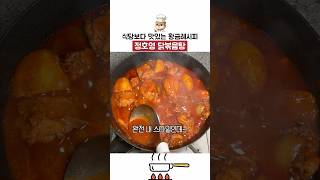 Chef Jung Ho-young's Golden Recipe Dakbokkeumtang: More Delicious Than Restaurants
 Pork Kimchi Jjigae: Try Cooking It This Way - Shimbangol Jubu's Golden Recipe for Kimchi Jjigae
 Foolproof Budae Jjigae
 Chef Im Sung-geun's Signature Pork Jjageuli Recipe
 Chef Jung Ho-young's Genius 7-Minute Beef Brisket Short Rib Soup
 Revealing the Secret to Making Delicious Pollack Stew (Dongtae-tang) with Zero Fishy Smell
 Try the TubeCookbook app — video analysis, saved recipes, shopping lists: the full cooking toolkitOpen →
Comments
Be the first to comment — how it turned out, or anything you want to ask.
